Submitted to the IEEE Journal of Oceanic Engineering

RIFT-Map: Flexible Transect-Tape Arclength Constraints for Metric Monocular Underwater Mapping

Code and derived data will be released here upon publication.

1.37%mean absolute length discrepancy on 31 tape intervals withheld along the whole 50-m transect
4.1%scale step at a one-camera join of the reconstruction, corrected by join rescaling from the tape
30 / 31admitted tape curves on a straight pool tape within 0.53% of their chord
3.16% → 0.23%scale error on a simulated curved tape, endpoint constraints versus curve lengths, 100 seeds

Abstract

Metric three-dimensional maps of coral-reef transects are needed to measure colony size and structural complexity over time. However, a single survey camera recovers the reef only up to an unknown scale that can also change along the pass. The flexible tape that divers lay along a transect could supply this scale but measures length along its curve rather than the straight distance between two readings. Therefore, we propose the Robust Integrated Flexible-Tape Mapping method to treat the transect tape as an observed curve of known material length. The method admits a tape interval only when a multiview support test confirms its interior. It rescales each segment of the scene-only reconstruction by the curve lengths of its own tape intervals. A robust consensus of curve lengths then sets the map scale. Bundle adjustment refines cameras, scene points and tape curves jointly with continuous arclength factors. On a straight tape in a pool, 30 of the 31 admitted tape curves stayed within 0.53% of their chord. We then mapped a 50-m coral transect near Koh Tao in Thailand with one action camera. In a leave-one-interval-out validation on 31 tape intervals along the whole pass, the method had a mean absolute length discrepancy of 1.37% and a root-mean-square discrepancy of 2.04%. These were the lowest values of six compared methods. The established three-camera workflow scaled by one scale bar reached 3.51% and 4.78%. In 100 simulated repetitions endpoint constraints enlarged the map of a curved tape by 3.16%. Curve lengths kept the scale error at 0.23%. These results show that a modeled tape curve with checked image support can provide the metric reference of monocular reef mapping.

Workflow and problems
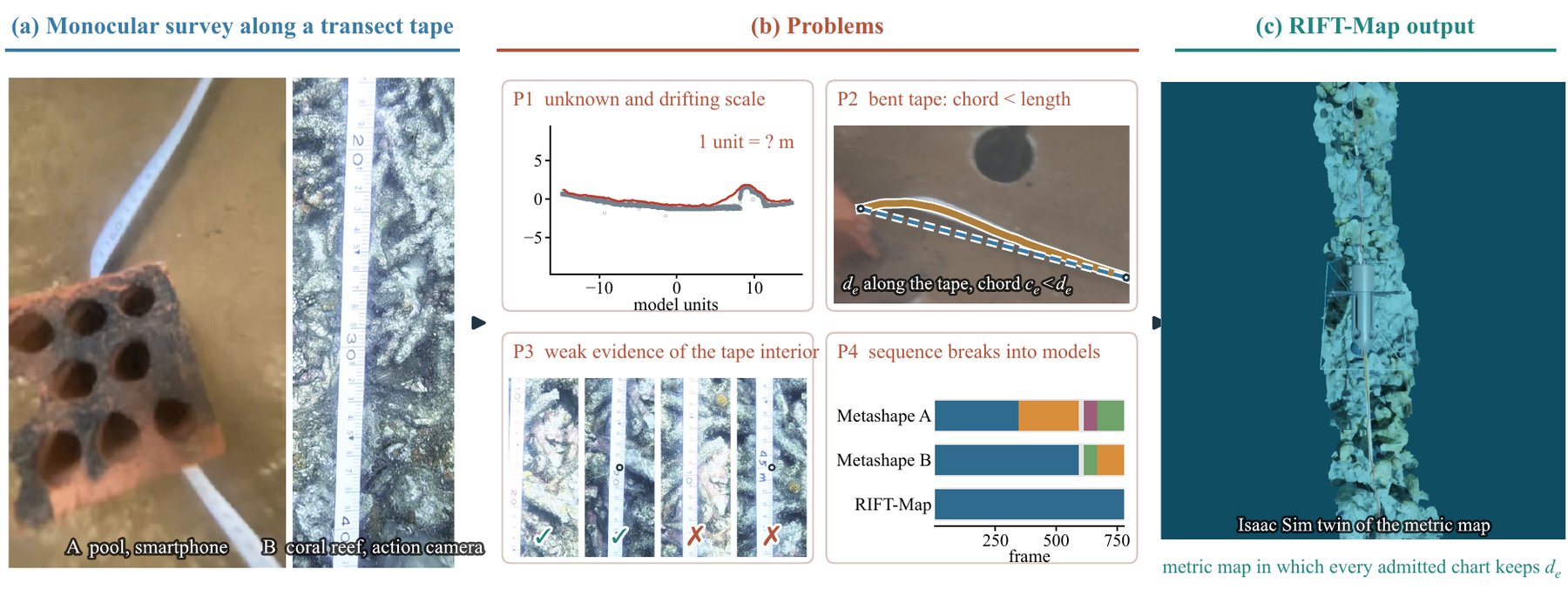
Workflow and problems of metric monocular transect mapping
Workflow and problems. A single camera records the transect tape in a pool and on a coral reef. The scale of a monocular reconstruction is unknown and drifts, the tape bends over the relief, its interior is often weakly observed, and a long sequence breaks into several models. RIFT-Map resolves these problems in one metric map whose tape intervals keep their material lengths.
Endpoint bias of a bent tape interval
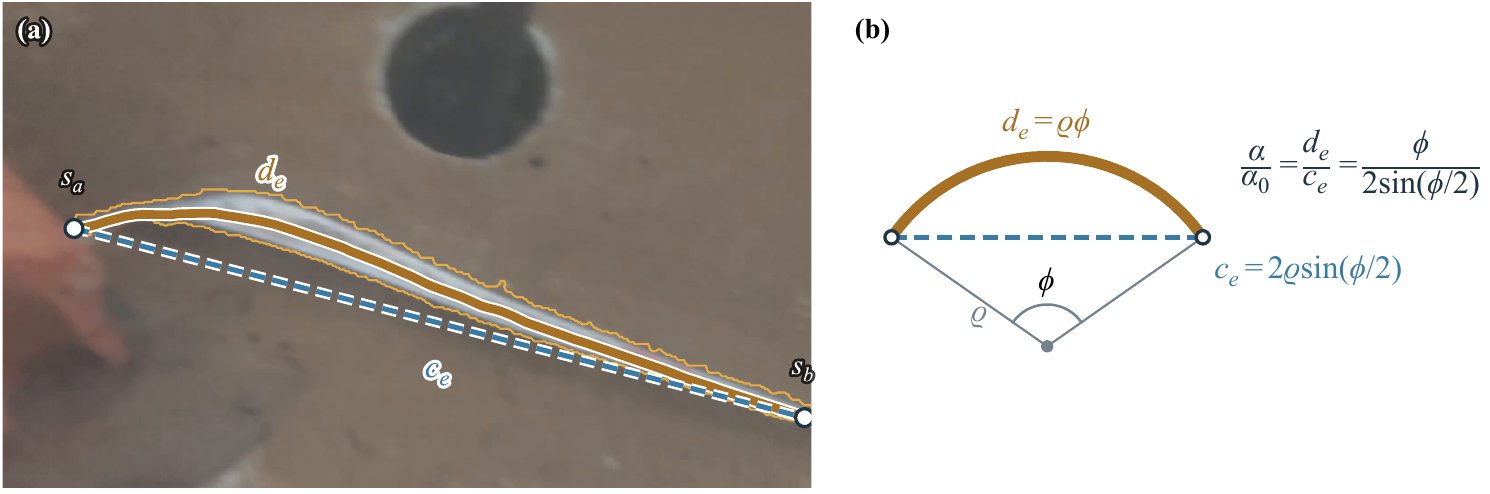
Why the tape is not a scale bar. The material length de follows the tape and the chord ce joins its readings. An endpoint constraint enlarges the map by de/ce, which is 11.1% for a bend of 90°.

Method

Stages of RIFT-Map
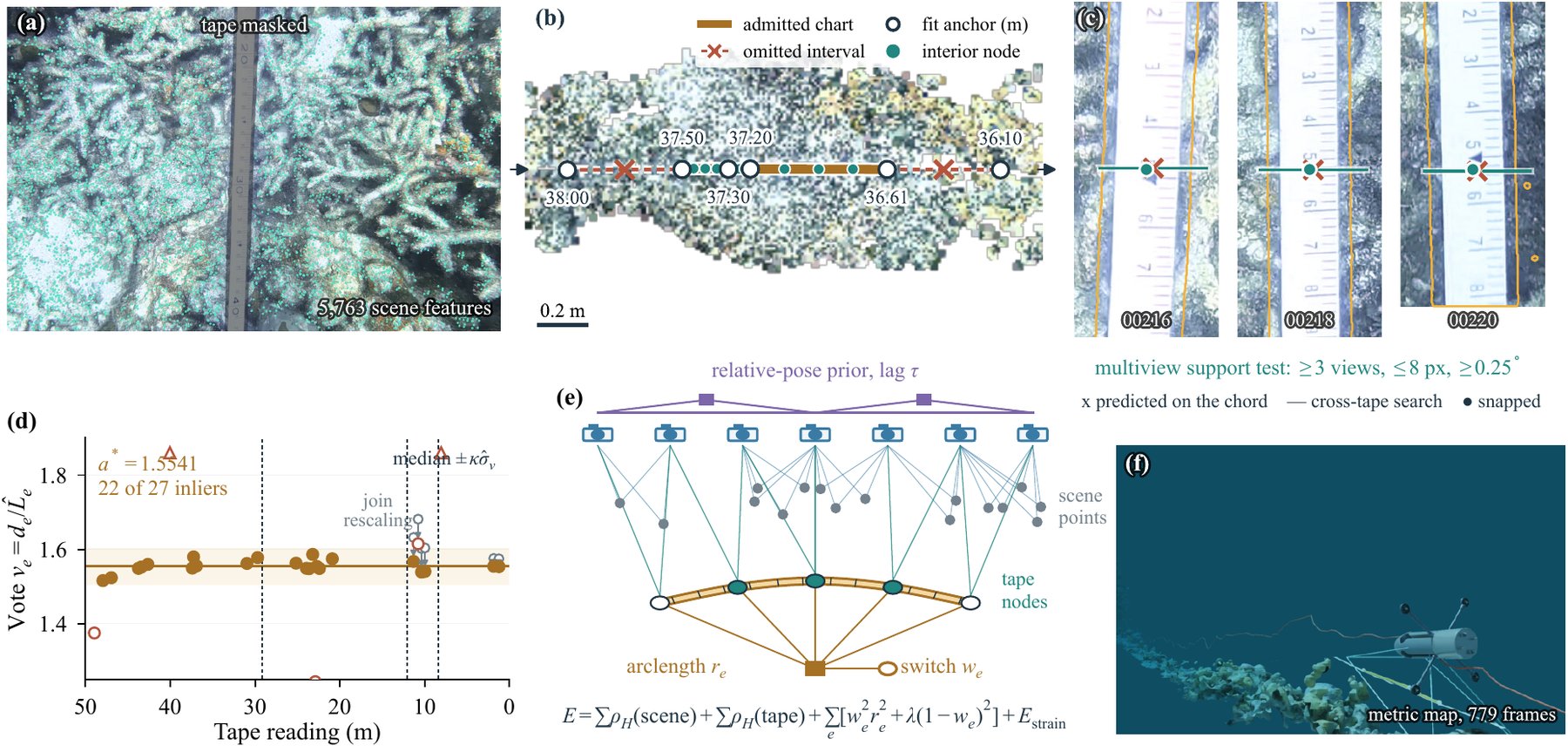
Stages of RIFT-Map on the coral transect. (a) Scene-only structure from motion with the tape masked. (b) Adjacent fit anchors propose tape intervals with five-node charts. (c) Interior nodes are predicted on the chord, snapped across the tape mask and kept only with at least three consistent views. (d) Chart lengths vote for the scale. Join rescaling corrects the scale of the segment after a one-camera join (grey to orange). (e) Bundle adjustment couples scene and tape reprojection with switchable Catmull-Rom arclength factors and an evidence-scaled trajectory prior. (f) Metric map.

Validation test scenario A: a tape in a pool

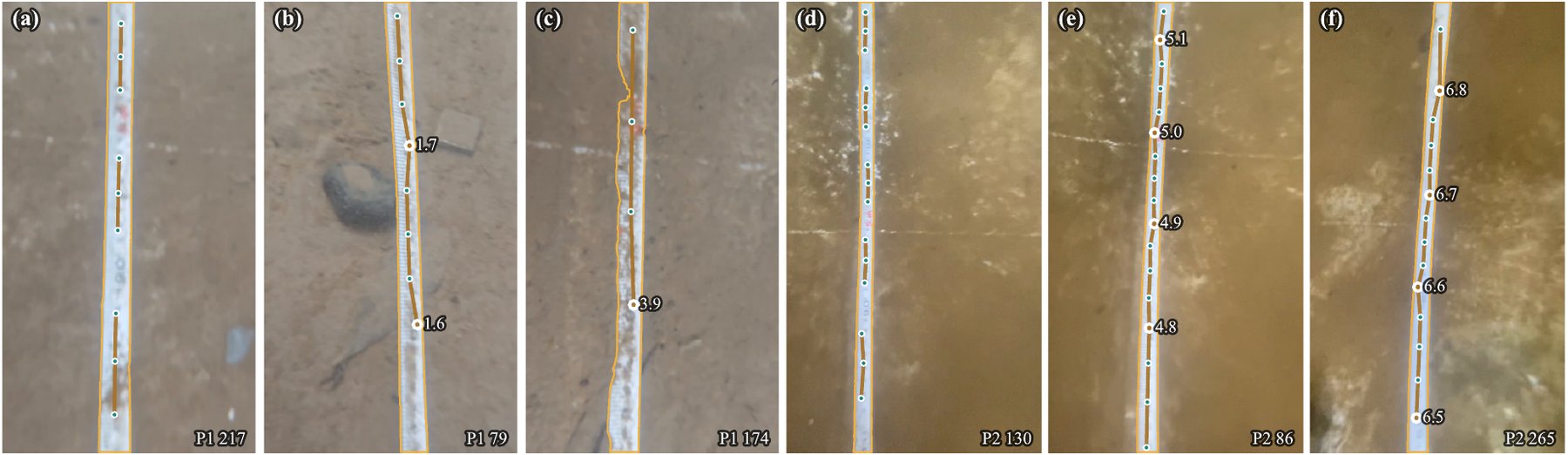
Smartphone video of a measuring tape on a pool floor validates the processing chain of RIFT-Map, from the semantic tape masks and the marked readings to the chart graph and its multiview support test.
Processing chain of RIFT-Map on pool frames
Processing chain in the pool. Semantic tape masks (yellow), marked readings (white) and the interior nodes of admitted charts (teal) snapped to the centre of the tape. On this straight tape 30 of the 31 admitted curves stayed within 0.53% of their chord.

Field test scenario B: a 50-m coral transect near Koh Tao, Thailand
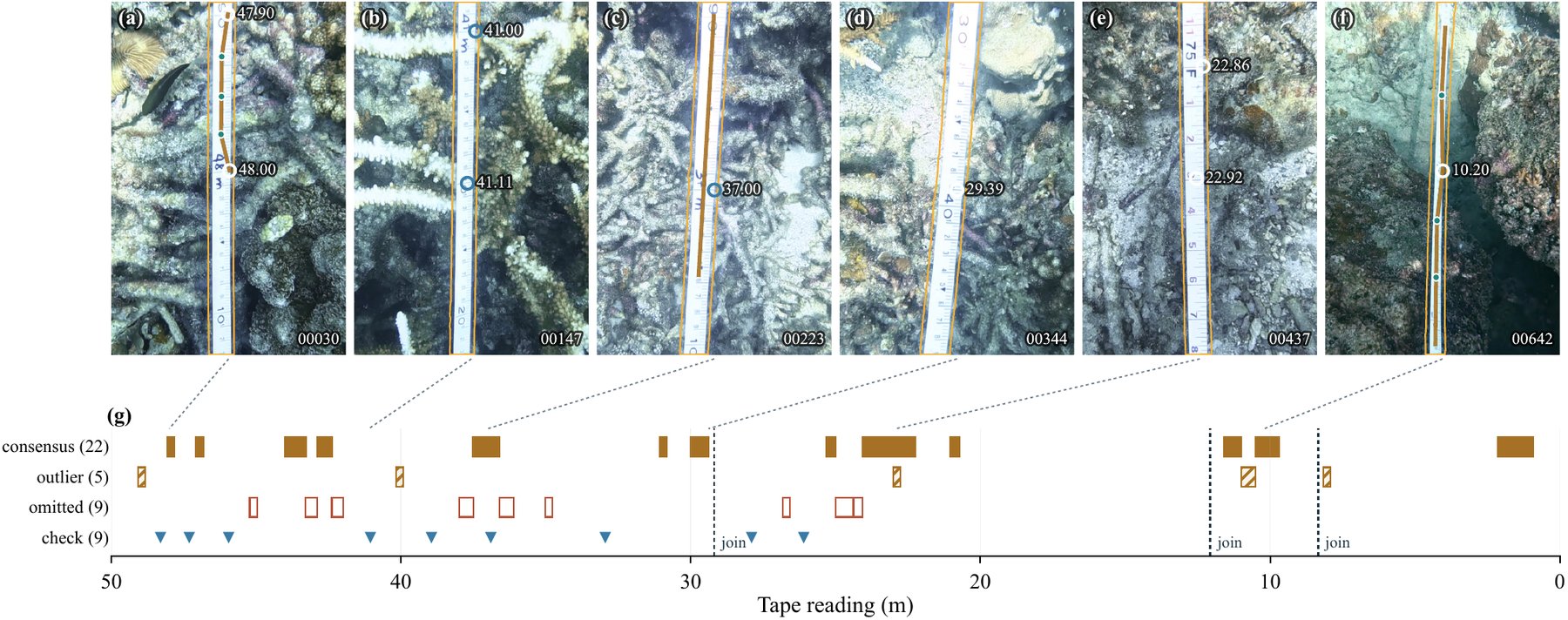
Frames and chart graph along the coral transect
Frames and chart graph. Six middle-camera frames along the transect with the tape mask, fit and check anchors and the interior nodes of consensus charts, aligned with the status of all proposed tape intervals. Dashed lines mark the joins of the scene-only reconstruction.
Metric map unrolled along the camera path
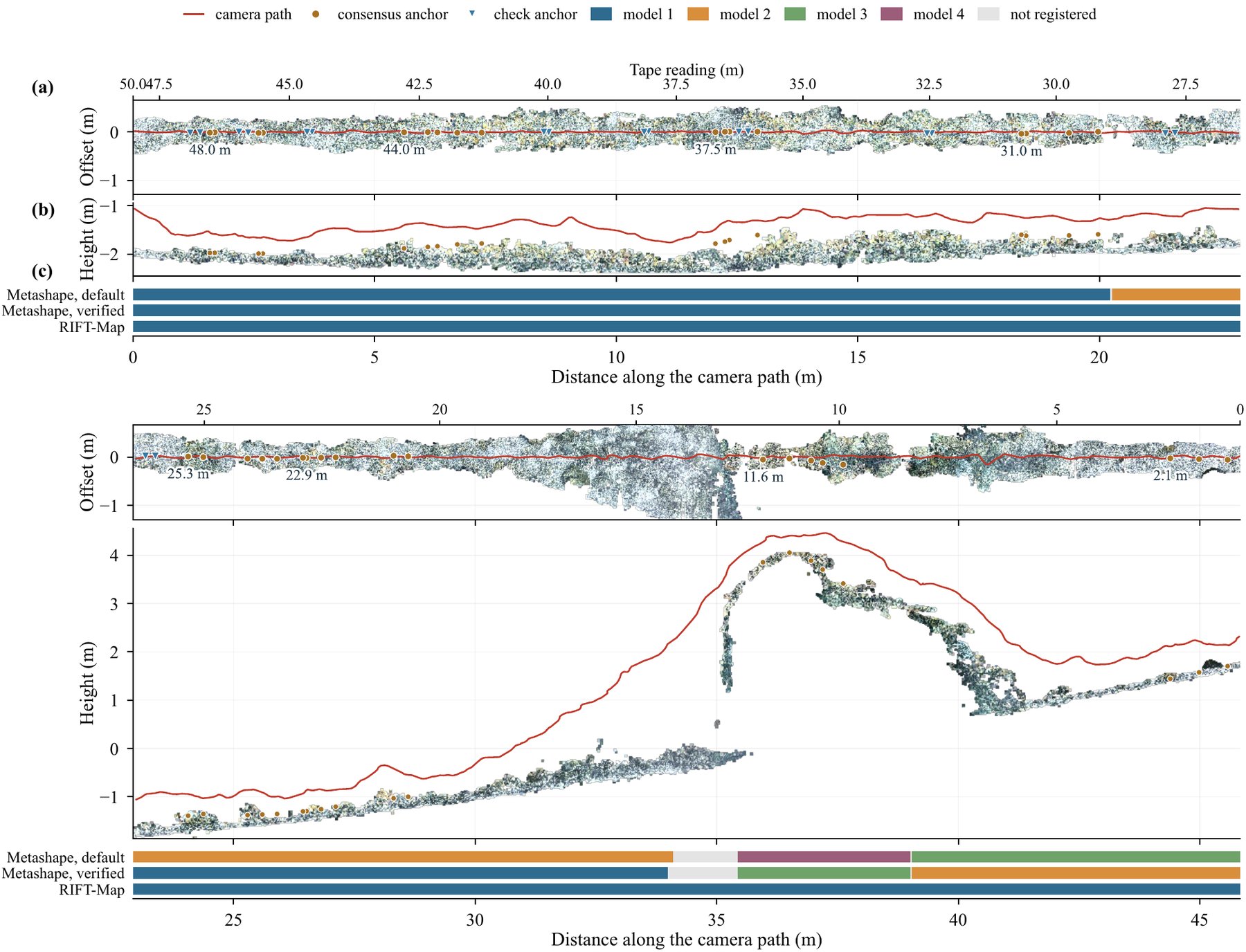
Metric map. Plan view, side profile at true scale and frame registration, unrolled along the camera path. Metashape on the middle camera alone split the 779 frames into three or four models.
Metric digital twin of the transect in Isaac Sim
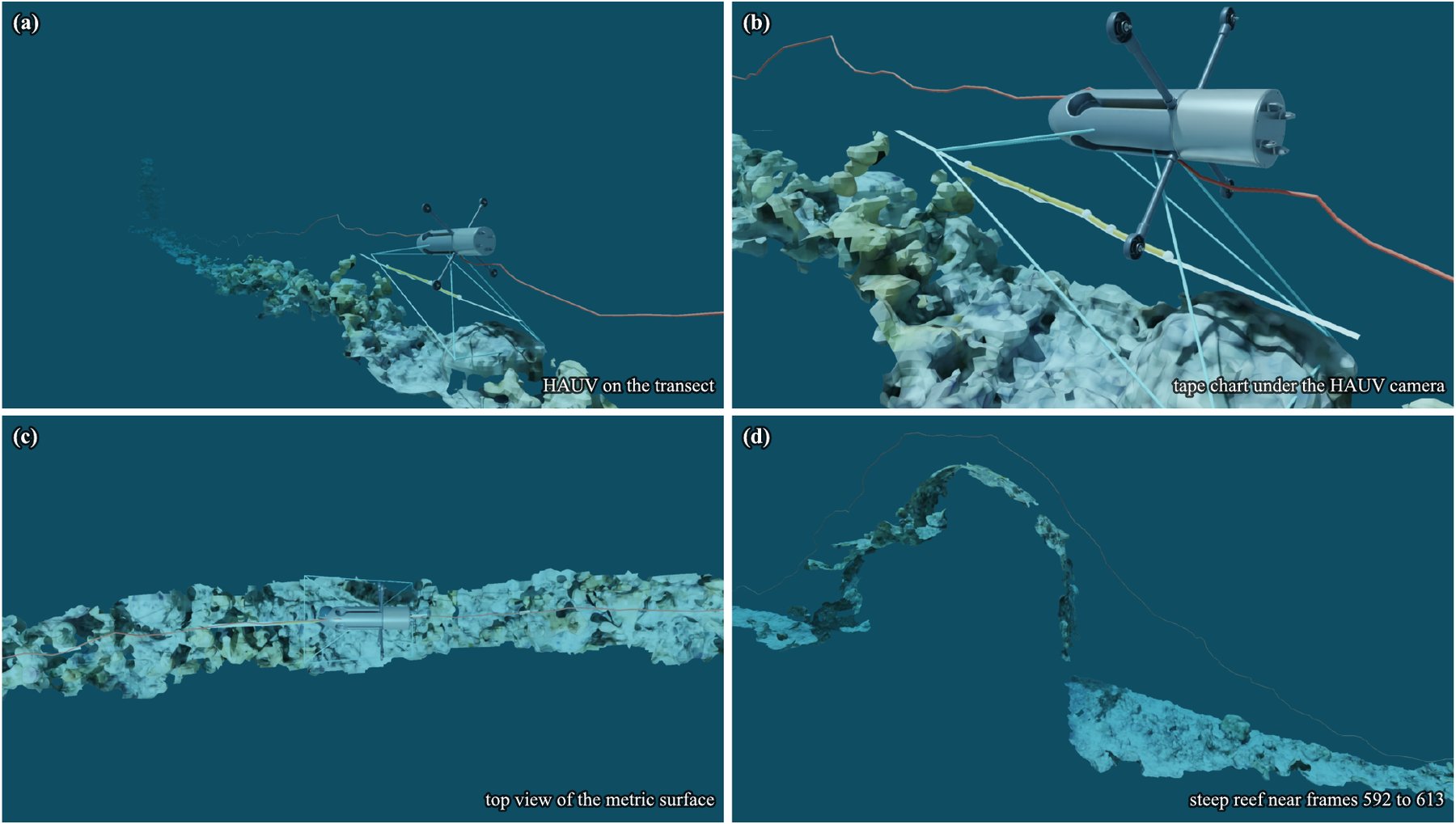
Metric digital twin in Isaac Sim. The reef surface, the tape, the consensus charts and the camera path at metric scale, with a hybrid aerial-underwater vehicle hovering above the tape. Panel (d) shows the steep part of the reef where Metashape lost frames 592 to 613. The median distance of the 621,724 map points from the surface is 2.8 mm.
Transect-wide validation on 31 withheld intervals
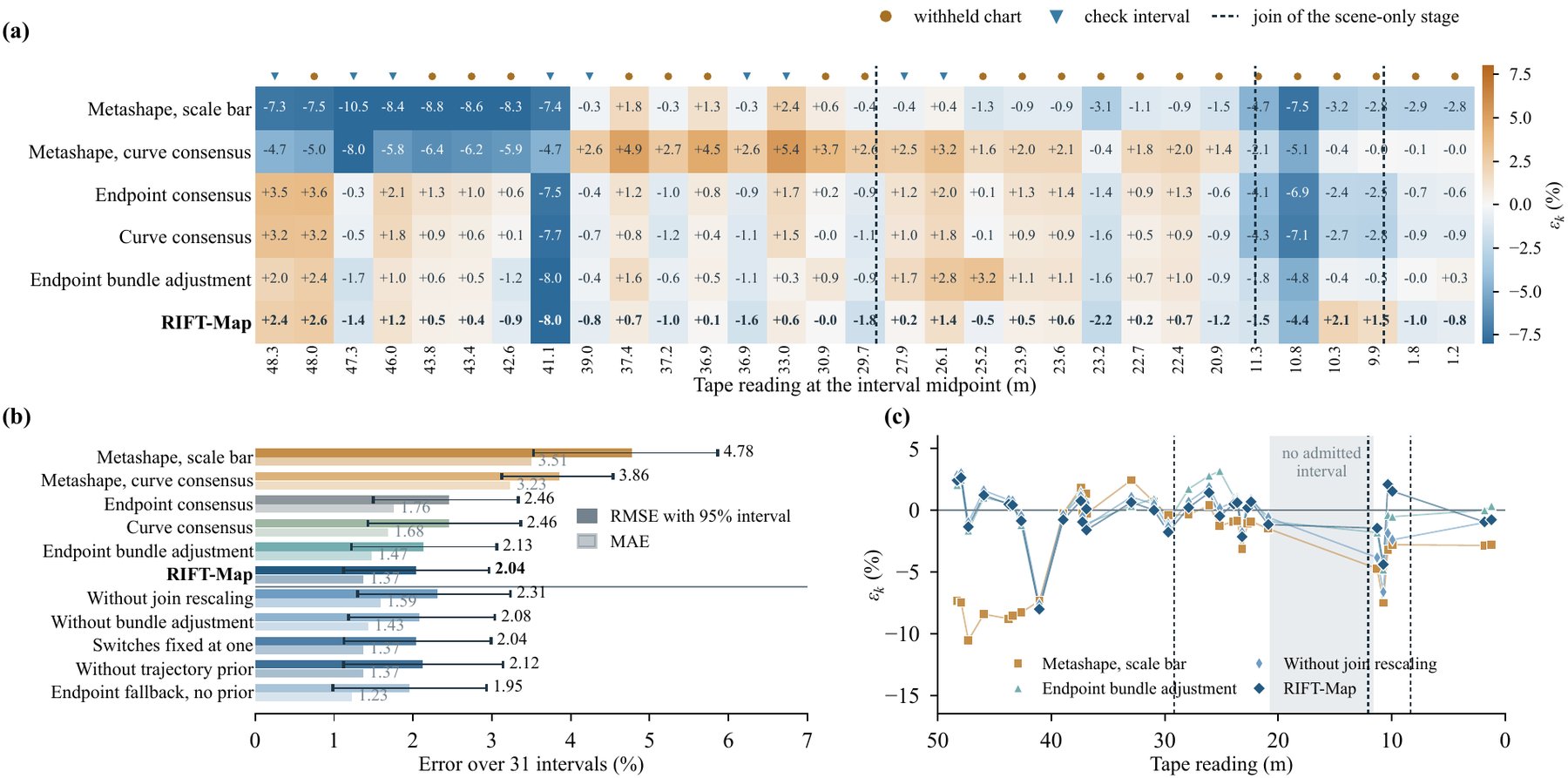
Leave-one-interval-out validation along the whole pass. Signed discrepancy of six methods on 31 withheld intervals, their RMSE with 95% bootstrap intervals and MAE, the ablations of RIFT-Map, and the discrepancy along the tape around the joins.
MethodMetric referenceMAE (%)RMSE (%)95% interval of RMSE
Three-camera Metashape workflowScale bar3.514.783.53 to 5.86
Three-camera Metashape workflowCurve consensus3.233.863.13 to 4.53
Endpoint consensusChord consensus1.762.461.50 to 3.33
Curve consensusArclength consensus1.682.461.43 to 3.37
Endpoint bundle adjustmentChord factors1.472.131.22 to 3.06
RIFT-MapArclength factors1.372.041.12 to 2.96

Controlled curvature analysis

Controlled curvature analysis
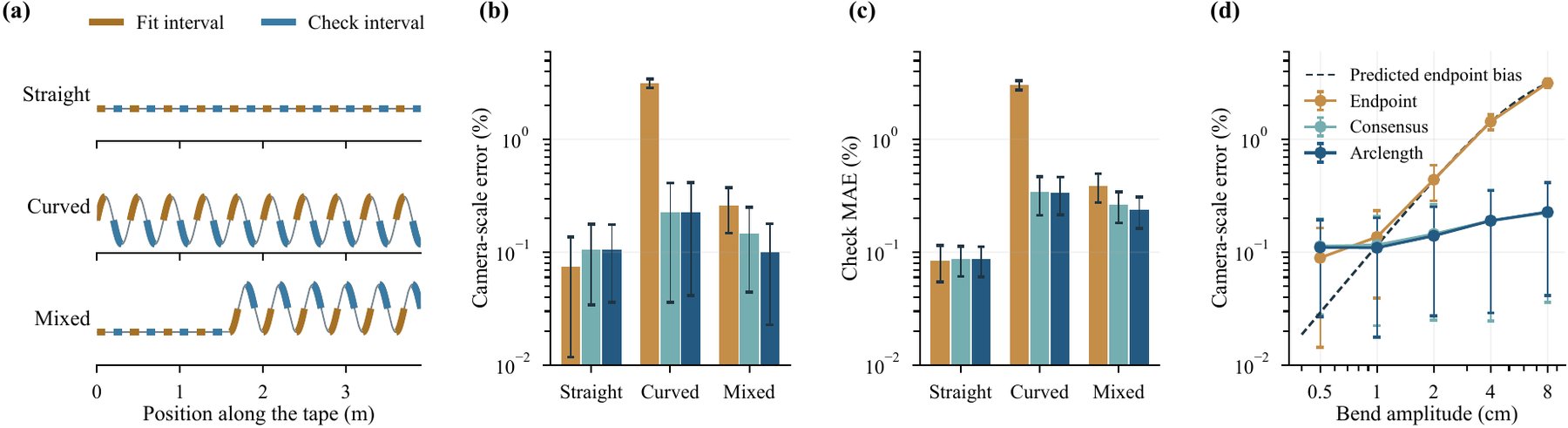
Simulated straight, curved and mixed tapes with 100 seeds each. On the curved tape an endpoint constraint enlarged the map by 3.16%, while the curve-length model kept the camera-scale error at 0.23%. The endpoint bias follows the ratio of material length to chord as the bend grows.

Citation

@article{riftmap2026,
  title   = {{RIFT-Map}: Flexible Transect-Tape Arclength Constraints for
             Metric Monocular Underwater Mapping},
  journal = {IEEE Journal of Oceanic Engineering (under review)},
  year    = {2026}
}